The scale of FABA generated from power plant operations provides a basis for exploring its further utilization. According to data presented by Mia Monasari during the talk show, Sumsel-8 PLTU generated approximately 132,400 tons of FABA in 2025, consisting of 114,600 tons of fly ash and 17,800 tons of bottom ash. HBAP also estimates that its FABA production could reach approximately 131,000–260,000 tons per year.
At the same time, agricultural demand provides another context for exploring the utilization of FABA. According to data presented by Fatoni Saputra, farmer groups requested 14.5 million tons of fertilizer in 2025, while the allocation of subsidized fertilizer stood at 9.55 million tons.
The figures highlight the importance of exploring alternative materials and solutions for the agricultural sector, while ensuring that any utilization of FABA complies with applicable technical requirements, safety considerations, quality standards, and relevant testing.
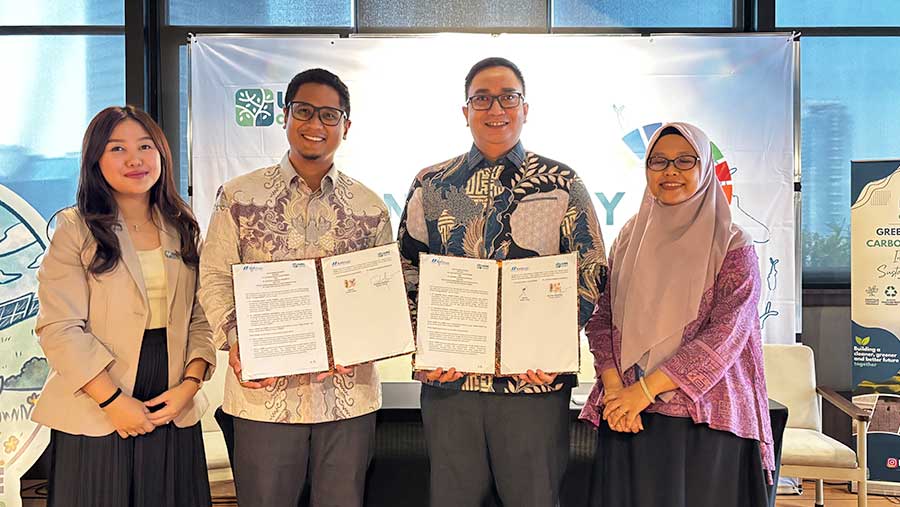
As a follow-up to the discussion, Lume Carbon and HBAP signed a Memorandum of Understanding (MoU) to explore cooperation in the collection and utilization of FABA generated from HBAP’s PLTU operations in South Sumatra. The MoU was signed by Hartono, Commercial Director of HBAP, and Rio Fafen Ciptaswara, CEO of Lume Carbon.
Under the proposed cooperation, Lume Carbon may collect FABA from HBAP’s operational facilities, with a potential volume of up to 10,000 metric tons per month. The initial phase will focus on exploring the utilization of FABA as a material that can be processed and developed into value-added products, including products that may support the agricultural sector.
As part of the initiative, Lume Carbon plans to explore investment in processing facilities and systems to develop FABA-based fertilizer products, subject to technical assessments, testing, applicable standards, and regulatory requirements.
“Lume Carbon is committed to contributing to addressing the gap in fertilizer demand while supporting Indonesia’s food security. Going forward, we will explore investment in a processing plant and facilities to produce fertilizer. This is one of Lume Carbon’s commitments,” said Rio Fafen Ciptaswara, CEO of Lume Carbon.
Meanwhile, Hartono, Commercial Director of HBAP, said the company views FABA not merely as a residue generated from PLTU operations, but as a material that may be further utilized to create added value, including for the agricultural sector and surrounding communities.
“HBAP is not merely a producer of FABA, but also seeks to promote its productive utilization and generate added value. One of the opportunities is to develop FABA into soil conditioners and fertilizer products to support the agricultural sector while creating benefits for the community,” said Hartono, Commercial Director of HBAP.
Through the cooperation, Lume Carbon and HBAP aim to explore the utilization of FABA as a resource that can be further processed to create added value, rather than being viewed solely as a material generated from PLTU operations.
The development will be carried out gradually, taking into account technical considerations, product quality, safety, availability, applicable regulations, and user requirements. Through this approach, the utilization of FABA is expected to contribute to the implementation of circular economy principles while supporting efforts toward food security and environmental sustainability.
(tim)